Blogs
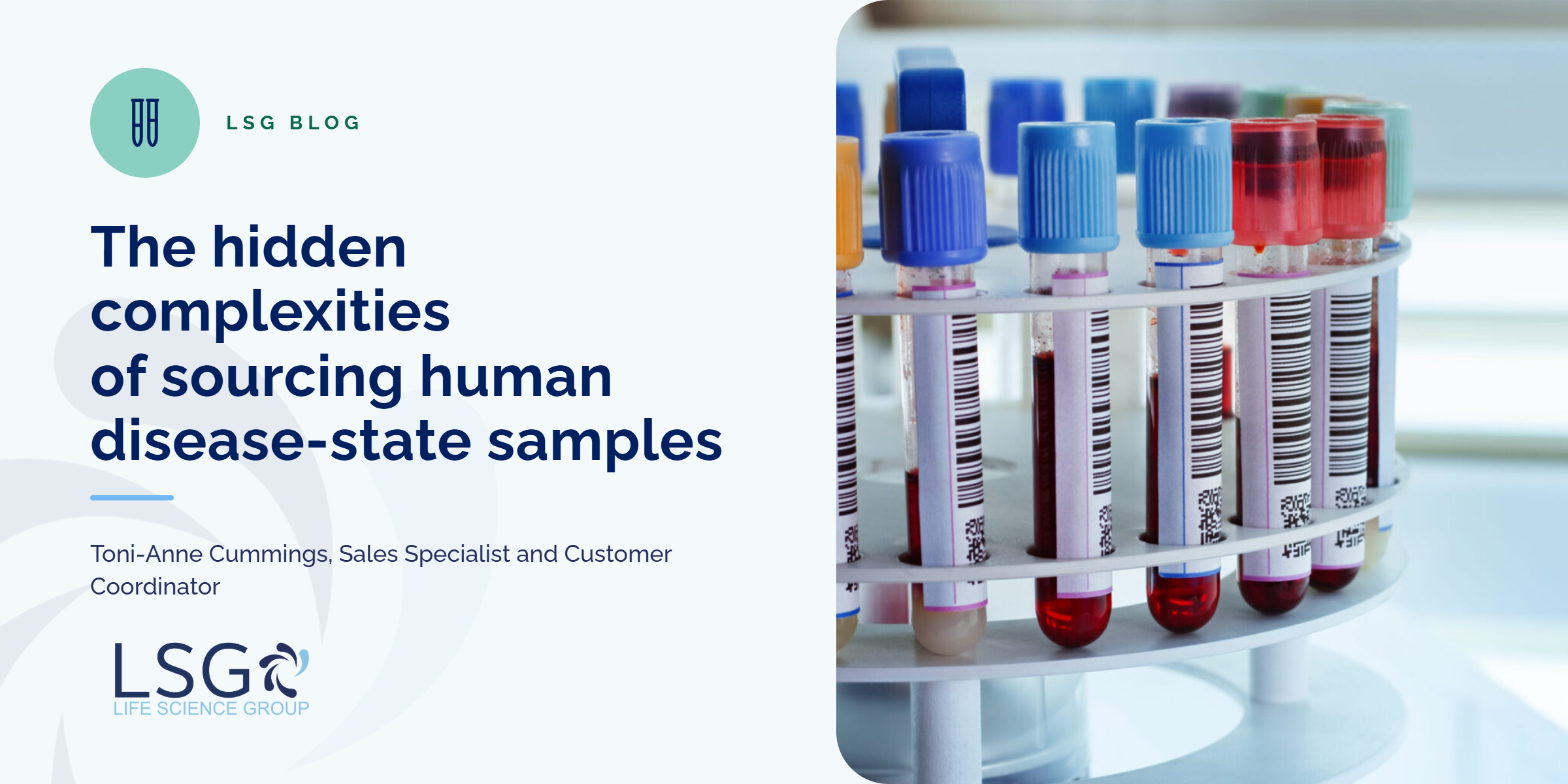

Human disease-state samples are incredibly valuable in research. These biospecimens support work across drug discovery, biomarker development, translational research, diagnostics and disease progression studies. But anyone who has worked with them knows that sourcing the right material is not straightforward.
A disease-state sample is not just a tube, a block of tissue or a line item on a request form. It comes from a real donor, with a real diagnosis, a clinical history and a set of circumstances that can all influence how useful that sample is to your research.
That is why getting the right sample starts well before collection. In this article, we look at what really decides whether a human biospecimen is fit for purpose: the study design, the protocol, prospective versus retrospective collection, and the clinical data that should travel with every sample.
• The right disease-state sample is defined by the research question, not just by what is available.
• A clear protocol sets out donor criteria, sample type, processing, storage and transport before collection begins.
• Retrospective collections are faster; prospective collections give more control over donors, matched sets and handling.
• Diagnosis, disease stage, medication and treatment history can matter as much as the sample itself.
• When there is no protocol, asking the right questions early prevents recollection and delays.
One of the most important parts of biospecimen sourcing is understanding what the researcher is actually trying to do.
Sometimes the request is very clear. Other times it starts with something broad, such as:
• “We need cancer tissue.”
• “We need matched blood.”
• “We need samples from donors at a specific disease stage.”
Those are useful starting points, but they are rarely enough on their own. To find the right material, we need to understand the study behind the request:
• What is being measured?
• What sample type is needed?
• Does the donor need to meet specific criteria?
• Are there medication or treatment exclusions?
• Is the sample being used for molecular analysis, cell work, histology, assay development or something else entirely?
These details matter because they decide whether the sample will be suitable once it reaches the lab.
A good protocol gives everyone clarity. It defines how the sample should be collected, processed, transported and stored, and it helps avoid assumptions that can cause problems later.
For example, a protocol can confirm:
• whether the collection needs to be prospective or retrospective
• what donor demographics are required
• whether matched sets are needed, such as tumour tissue with blood, plasma or PBMCs
• which diagnosis or disease stage is relevant
• whether the sample needs to be frozen, fixed or fresh
• what volume or concentration is required
• whether certain medications or treatments need to be excluded
This is not just admin. It is part of protecting the quality of the research.
A sample may be technically available, but if it has been collected or handled in the wrong way, it may not answer the question the researcher is asking. For fresh tissue in particular, time to processing, temperature and the right tissue transportation medium all play a part in keeping the sample fit for purpose.
One of the first things to clarify is whether the study needs a prospective or a retrospective collection.
A retrospective collection uses samples that have already been collected and stored. This can be helpful when timelines are tight or when suitable material already exists. The limitation is that you may not be able to go back to the donor for additional samples or extra information.
A prospective collection is planned before the sample is taken, which gives more control. The right sample types can be collected at the right time, from the right donor, using the right handling conditions.
|
|
Retrospective collection |
Prospective collection |
|
Timeline |
Faster – the material already exists |
Longer – collection is planned and scheduled |
|
Control over collection and handling |
Limited to how samples were originally taken |
Defined by your protocol |
|
Going back to the donor |
Usually not possible |
Recall and extra samples can be built in |
|
Best suited to |
Tight timelines and readily available sample types |
Matched samples, specific collection methods, donor recall and medication exclusions |
For studies needing matched samples, specific collection methods, donor recall or medication exclusions, prospective collection can make a big difference.
With disease-state samples, the context can be just as important as the sample itself. Information such as diagnosis, disease stage, and medication and treatment history all matter.
Without that context, researchers can be left trying to interpret results with only part of the picture. This is especially important where medication or treatment history could influence biomarkers, analyte concentrations, cell behaviour or other readouts.
It is easy to think of these details as “nice to have”. In practice, they can be the difference between a useful sample and one that creates uncertainty.
It is not uncommon for a request to arrive without a full protocol. When that happens, the priority is to ask the right questions early:
1. Is this a prospective or retrospective requirement?
2. How many donors are needed?
3. Are there gender, age or other demographic requirements?
4. Are there any geographic exclusions?
5. What volume is needed per donor?
6. Are matched samples required?
7. Can frozen material be accepted?
8. If whole blood is required, can it be frozen to make transport easier?
9. Are there medication or treatment exclusions?
10. What documentation will be needed?
These questions can feel detailed at the start, but they save time later. They reduce the risk of collecting the wrong material, needing to recollect, delaying the study or supplying a sample that does not truly fit its intended use.
Good biospecimen sourcing is not just about finding what is available. It is about matching the research question to the right donor, the right collection method, the right documentation and the right handling conditions. That means working across researchers, collection centres, clinical teams, ethics requirements and logistics. With so many moving parts, planning matters.
The most useful disease-state samples are not always the rarest or the highest volume, but the ones collected with a clear purpose. When the right questions are asked early, the sample is more likely to arrive with the context, quality and documentation needed to support meaningful research.
At LSG, we take the time to understand your study before helping to source the specimens you need. Explore our biospecimen sourcing service or talk to our team about your requirements.
Human disease-state samples are biospecimens, such as tissue, whole blood, serum, plasma or PBMCs, collected from donors with a confirmed diagnosis of a specific disease. They are used in drug discovery, biomarker research, diagnostics development and studies of disease progression.
Retrospective collection uses samples that have already been collected and stored. Prospective collection is planned in advance, so samples are taken to a defined protocol, from donors who meet set criteria, under agreed handling conditions.
Matched samples are different sample types taken from the same donor, for example tumour tissue alongside blood, plasma or PBMCs. They let researchers compare results across sample types from one individual.
Depending on the study, this can include donor demographics, diagnosis and disease stage, medication and treatment history, and details of how the sample was collected, processed and stored, along with the documentation the study requires.
This article was written by Toni-Anne Cummings, Sales Specialist and Customer Coordinator at Life Science Group (LSG).
LSG is a full-service, UK-based CDMO for aseptic liquid, custom antibody, serum and specimen needs. We combine scientific expertise with agile, accredited manufacturing to support a growing customer base across the cell culture and molecular biology fields.